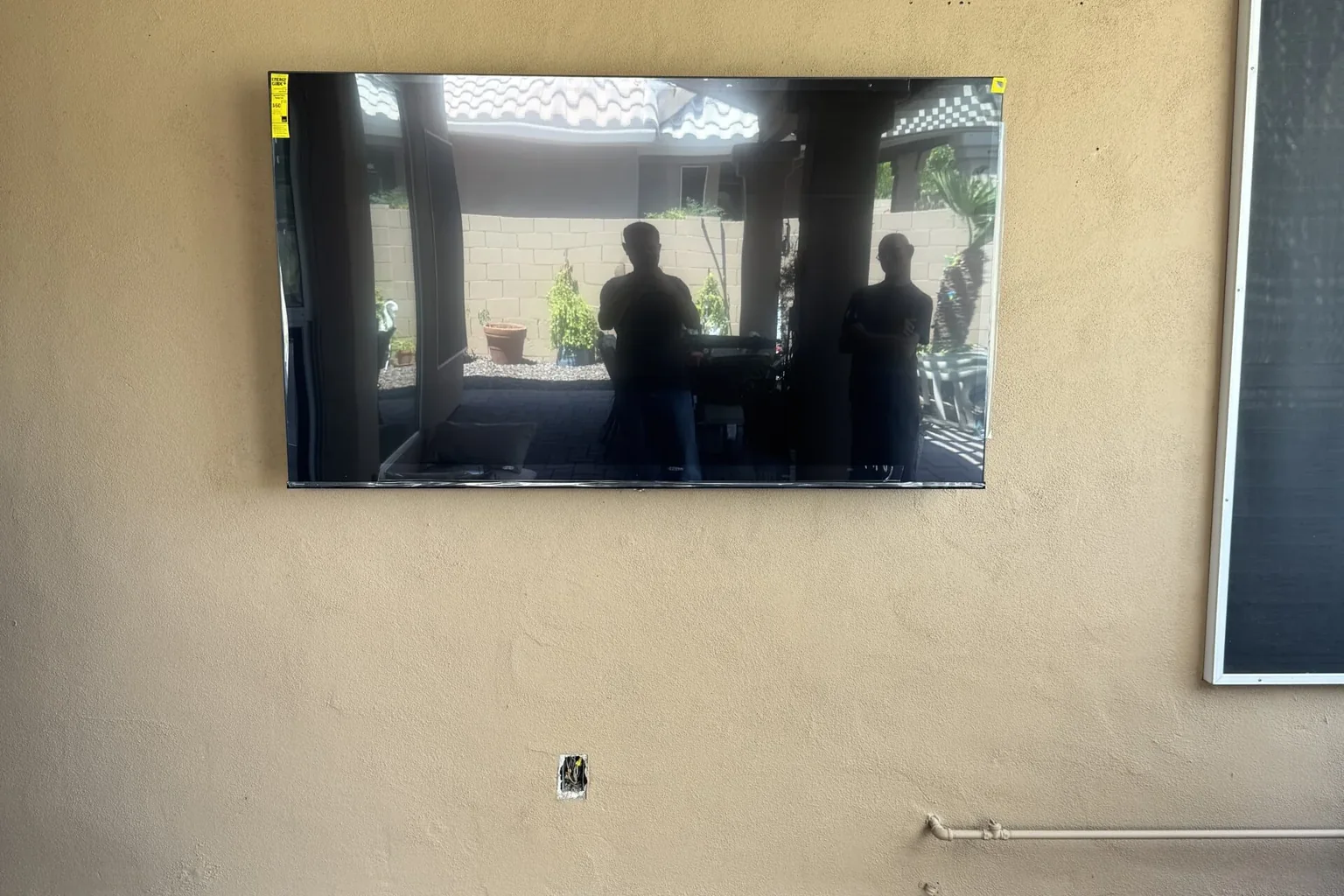
What should you check before mounting a TV?
Before I drill anything, I answer four questions: What is the wall made of? Where is the structure behind it? Is the mount rated for the TV? How will power and signal cables reach the screen safely?
That short check prevents most bad outcomes. A mount can look level and still be wrong if the fasteners do not match the wall, the bracket blocks a TV input, or the planned cable path crosses something it should not.
I’m Joe Machynia, the owner and solo operator of HandyMack. I handle TV mounting from my Stetson Valley and Deer Valley base across Phoenix, Peoria, Glendale, Surprise, and Sun City. Valley homes are not all built the same, so I treat the wall in front of me as the source of truth.
Match the fastening plan to the wall
Drywall over wood framing
For a typical framed wall, I locate the studs and confirm their spacing before choosing the bracket position. The mount manufacturer's instructions determine the approved fastener pattern and weight limits. I do not assume a couple of generic drywall anchors are an adequate substitute for structural attachment.
Drywall over metal framing
Metal framing needs a different fastening plan. The TV size, bracket geometry, stud gauge, and wall construction all matter. If I cannot verify a safe attachment, I stop instead of improvising.
Concrete, block, brick, or stone
Masonry can provide a solid mounting surface, but only with the right bit, anchor, embedment, and drilling location. Block can be hollow, stone veneers may not be structural, and a fireplace surround can hide more complexity than it shows.
An uncertain or damaged wall
Fresh paint does not tell me what is behind the drywall. If a stud reading is inconsistent, the wall shows previous damage, or the planned position conflicts with plumbing, electrical, or a pocket door, the right move is more investigation or a different location.
Which TV mount should you choose?
A fixed mount keeps the screen close to the wall. It is a good fit when the seating position and viewing angle are straightforward.
A tilting mount helps when the screen needs to sit above seated eye level or when glare changes through the day.
A full-motion mount can swivel and extend, which is useful in an open room or corner. That movement also creates more leverage on the wall, so the attachment and mount rating deserve extra attention.
Before buying, check:
- The TV's VESA mounting pattern
- The TV weight without its stand
- The mount's stated size and weight limits
- Whether the mount leaves access to power, HDMI, antenna, and network ports
- How far the screen needs to extend or tilt
- Whether the included hardware actually matches your wall
The mount instructions and TV manual outrank any generic internet chart.
How high should a TV be mounted?
There is no single height that works in every room. I start with the main seated viewing position and aim for a comfortable, natural line of sight. Then I account for the screen size, furniture, soundbar, outlets, windows, and how the room is used.
A painter's-tape outline on the wall is one of the best planning tools. Sit where you normally watch, look at the outline, and live with it for a few minutes. That is more useful than choosing a height from a photo.
Fireplace mounting needs additional judgment. The screen may end up uncomfortably high, and fireplace clearances or heat exposure can affect what is appropriate. I follow the fireplace and TV manufacturers' requirements and will recommend another location when the setup is not a good fit.
What is the safe way to hide TV cables?
Low-voltage signal cables and household power are different jobs.
For HDMI, coax, Ethernet, or speaker cable, I can use an appropriate in-wall-rated cable when the wall and route allow it. A surface raceway is often the cleanest answer on masonry, insulated walls, or any wall where fishing cable would create unnecessary damage.
I do not put a TV's ordinary detachable power cord inside a wall. If the project needs a new receptacle, new branch-circuit wiring, or other line-voltage electrical work, that portion belongs with a licensed electrician. A listed power-relocation product may be an option when installed exactly as its instructions and local requirements allow.
Is wall mounting safer than using a TV stand?
A correctly mounted flat-screen removes the TV from furniture that a child could climb. The U.S. Consumer Product Safety Commission recommends mounting flat-screen TVs or otherwise securing TVs and furniture to reduce tip-over hazards. See the CPSC Anchor It guidance.
Wall mounting is not a reason to ignore nearby furniture. Dressers, consoles, and bookcases may still need their own anti-tip restraints, especially in homes where children visit.
What I can help with
I can help with the handyman-sized portion of a TV setup:
- Confirming the proposed wall and mount are a sensible match
- Installing compatible fixed, tilting, and full-motion mounts
- Positioning and leveling the screen
- Mounting a compatible soundbar
- Routing suitable low-voltage cables or installing a surface raceway
- Connecting and testing the devices already in the room
I do not add electrical circuits or receptacles, alter fireplaces, or perform work that requires a licensed trade. If that is part of the plan, I separate it clearly so the right professional handles it.
TV mounting FAQs
Can you mount a TV on block or concrete?
Often, yes. I first confirm what the finished wall and structural material actually are, then match the anchors and mount instructions to that condition.
Should I buy the mount before booking?
You can. Send the TV model, mount model, a straight-on photo of the wall, and a photo of nearby outlets. I can flag obvious compatibility issues before the visit.
Can you hide every cable?
Not always. The wall cavity, insulation, fire blocking, masonry, and cable type determine what is practical. A neat surface raceway is sometimes the safer and less destructive result.
Do I need an electrician?
You need a licensed electrician when the plan calls for new line-voltage wiring, a new receptacle, or another electrical change outside handyman scope. Mounting and low-voltage cable management can often proceed separately.
Do you serve my part of the Valley?
I am based in the North Valley and serve Phoenix, Peoria, Surprise, Sun City, and Glendale, with Scottsdale considered case by case.
Make the wall plan before buying the bracket
See my TV mounting service for the work I handle. If mounting is one item on a longer list, the guide to small handyman projects that change how a room works may help you group the visit.
Send the TV model, mount model, wall photos, nearby outlets, and ZIP code through the quote page. I can usually spot the first compatibility question from those details before a drill comes out.