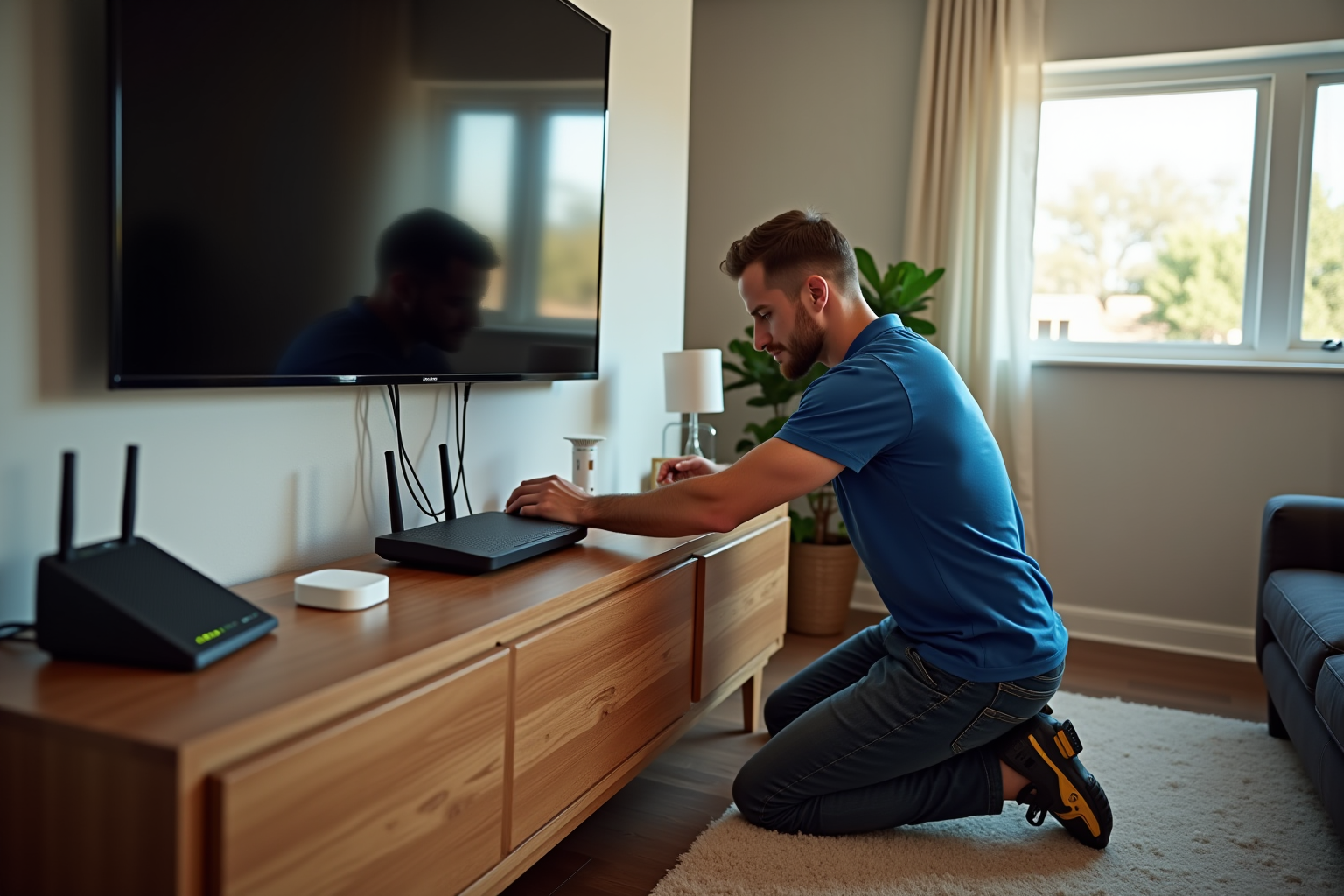
Most Phoenix homes have a quiet pile-up: a TV that never got mounted, a Wi-Fi dead spot in the back bedroom, a camera box still in the closet, cords hanging off the back of the console, and a grab bar someone's been meaning to install for a parent. None of it is an emergency. All of it is sitting there because booking three different people for three small things feels like more work than the work itself.
That's the gap I fill. I'm Joe, I run HandyMack solo out of the North Valley, and the whole point of the business is that the tech side and the handyman side show up in the same truck. Not because it's a clever line on a website. Because that's genuinely how the work piles up in a real house.
Here's what actually combines well in one visit, what I'll pass on, and where the line is between you, me, and a licensed trade.
What combines cleanly in one visit
Wi-Fi first, then everything that depends on it. This is the one most people get backwards. They mount the TV, set up the camera, install the smart thermostat, then wonder why the bedroom camera drops every night. If the network placement is bad, every device sitting on top of it is bad too. So I start with the router and the mesh nodes. Where the router sits, what's between it and the far room (block walls, a kitchen full of appliances, a metal garage door), and whether a second node actually fixes the dead spot or just wastes money. Phoenix construction eats Wi-Fi: block and stucco walls, a hot attic full of ductwork, denser than the drywall-and-stud homes up north. Placement usually matters more than a new router. If the dead spot is the real problem, five signs your home Wi-Fi needs an upgrade breaks that down.
Device setup after the network is solid. Smart plugs, a video doorbell, a smart thermostat, a couple of cameras. The boring part nobody budgets time for is the app side: getting them on the right network, naming them something useful, updating firmware that's been sitting since the box shipped, and walking you through which notifications to leave on. A camera that screams at you every time a lizard crosses the yard gets turned off inside a week. If you want a cleaner starting point, the smart-home setup page covers what that looks like end to end.
Mounting and cord cleanup. TV on the wall, soundbar, the console underneath. The visible win is the TV. The part people actually live with is the cords. I pull them off the wall and clean up the run, and where it makes sense I chase them behind the drywall. Here's the boundary on that, and I'm strict about it: I can route low-voltage cables (HDMI, ethernet, camera runs) behind the wall. I do not install a new 120-volt outlet behind a mounted TV. That's licensed electrical, full stop. If you want power back there, I'll set up the low-voltage side and point you to a licensed electrician for the receptacle, or you use a code-compliant power kit. I'm not the guy who hides a romex run to save a trip.
Motion lighting for safety and aging-in-place. Battery and solar motion lights, plug-in low-voltage step lights, a light on a sensor so an older parent isn't walking a dark hallway at 2am. I mount them, aim them, and set the sensitivity so they're not firing every time the neighbor's cat walks by. The boundary is the same as the TV: if it needs a new hardwired 120-volt junction box, that's licensed electrical and I'll tell you before I touch it.
The small punch list. This is where one visit actually saves you money. While I'm there for the TV and the Wi-Fi, I can mount a grab bar with the correct fasteners and solid backing for the wall construction, assemble the shelf unit still sitting in the box, patch the drywall anchor holes from the old mount, swap a door handle, or clip the cable run along the baseboard. I verify the wall assembly and don't guess. None of these are jobs worth a separate trip fee on their own. Stacked onto a visit that's already happening, they're just the add-ons.
What I don't do in that visit
Licensed electrical, plumbing, and HVAC. A panel upgrade, a new circuit, moving a sink, replacing a furnace. I refer those out. I'm not a licensed tradesman, and the honest version of "one visit does it all" is that I do everything inside my lane and hand you the name of the right person for the rest. If a job turns out to be licensed work once I see it in person, I stop and say so. I'd rather leave a clean explanation than do work I shouldn't.
DIY, me, or a licensed trade
A quick version of the boundary I use:
- DIY it if it's battery-powered, self-adhesive, or a simple app setup with no wall work. A plug-in mesh node or a smart plug is usually straightforward. Only handle a doorbell when you've confirmed it's low voltage and can follow the manufacturer's instructions. If the wall structure, power, or wiring is uncertain, stop and call the right person.
- Call me when it needs a drill, a stud, a ladder, a network diagnosis, or a few small things done at once. Mounting, low-voltage cable runs, grab bars, cord cleanup, camera placement, motion lights that need aiming. Anything that stacks.
- Call a licensed trade the moment it touches the panel, a new 120-volt circuit, gas, main plumbing, or HVAC load. I'll tell you which one and why.
How a combined visit is priced
The service call is $125, and that covers travel and the first hour. After the first hour, general home and tech work is $75 an hour, and Home Assistant specialist work is $95 an hour. The thing that makes a combined visit worth it: the add-ons stack onto a visit that's already booked, so you're not paying a second trip fee to hang a grab bar or clean up cords. Hardware and materials are separate. I'll tell you what I'm bringing and what it costs before I buy it, not after.
A Phoenix-specific note
Heat and dust shorten the life of anything electronic that isn't vented or shaded. An attic that hits 140-plus will cook a mesh node you tucked up there to "get it central." Outdoor cameras aimed west into the afternoon sun fail faster than the same camera aimed north. Monsoon moisture finds the one unsealed penetration on a cable run. I factor all of that into placement, because the install that lasts here isn't the same as the one that works in a cooler climate.
Want this handled in one visit? HandyMack serves the Phoenix North Valley, including Stetson Valley, Deer Valley, Peoria, Surprise, Sun City, Glendale, and surrounding areas. Text a couple photos of what's piled up and I'll tell you what makes sense before you spend money. Book a visit.